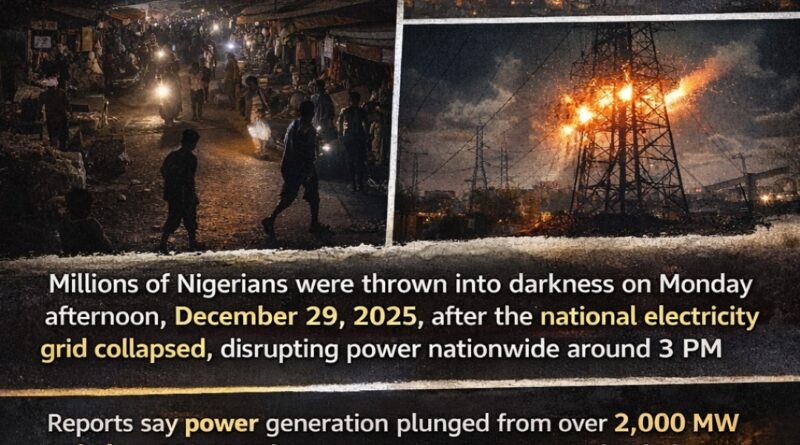
NIGERIA’S NATIONAL POWER GRID COLLAPSES AGAIN, PLUNGING COUNTRY INTO DARKNESS
Nigeria was thrown into widespread blackout on Monday afternoon, December 29, 2025, after the national electricity grid suffered a major collapse, cutting power supply across the country and leaving millions of homes, businesses and public services without electricity. At around 2:01 p.m., the country’s national grid experienced a system disturbance that triggered a cascade of failures across the transmission network, disrupting power generation and distribution. Electricity generation, which had peaked at roughly 4,800 megawatts, plunged dramatically to about 139 MW by mid-afternoon.
WIDESPREAD OUTAGE AFFECTS DISCOs NATIONWIDE
Distribution load data from the national grid showed that only a few electricity distribution companies were receiving minimal supply at the height of the collapse. The Ibadan Electricity Distribution Company (IBEDC) was allocated 30 MW, while the Abuja Electricity Distribution Company (AEDC) received about 20 MW of power — with all other major DisCos, including Eko, Enugu, Jos, Kano, Kaduna and Port Harcourt, receiving zero megawatts at the peak of the outage. Across the country, homes went dark, traffic lights went out, industrial operations halted, and businesses faced energy disruption at a critical time of the year. The total electricity supplied nationwide stood at a fraction of normal levels, leaving major urban and rural areas without reliable power for several hours.
CAUSES AND SECTOR CHALLENGES
Early reports from grid operators indicate that the system disturbance may have involved the tripping of multiple generating units and critical 330 kV transmission lines, though a definitive cause has not been confirmed. Analysts and industry experts suggest that weak infrastructure, ageing transmission systems, gas supply constraints and reduced generation capacity could be factors exacerbating grid fragility. Earlier in December, Nigeria’s power sector was already under strain following the vandalism of the Lagos-Escravos-Lagos gas pipeline, which supplies fuel to many thermal power plants. The disruption in gas supply has lowered generation output in power plants and made the grid more vulnerable to system disturbances. Nigeria’s national power grid has suffered multiple collapses in recent years, reflecting chronic challenges in the country’s energy infrastructure. Despite ongoing reforms and investments, consistent stability and reliability of the grid remain elusive, impacting economic activities and quality of life.
RESTORATION AND RESPONSE
Following the collapse, the Nigerian Independent System Operator (NISO) and other stakeholders activated emergency response procedures to stabilise the grid. According to official statements, measures were taken to restore supply, with some generating complexes operating in “island mode” to maintain limited power to select substations while full system normalization was achieved. By the evening of the same day, power supply was reported to be gradually returning to different parts of the country, and grid stability was restored after coordinated efforts by operators and technicians. Investigations were announced to determine the exact sequence of events that led to the collapse and to implement preventive measures for future occurrences.
IMPACT ON NIGERIANS AND THE ECONOMY
The blackout left many Nigerians stranded without electricity in homes and workplaces. Businesses — especially those heavily dependent on power — reported losses, and critical infrastructure such as hospitals and transportation systems were forced to rely on standby generators. The timing of the outage at the tail end of the year further heightened frustrations over chronic energy instability in the country. Energy experts say the frequent grid failures continue to undermine investor confidence and economic growth, reiterating the need for stronger investment in transmission infrastructure, reliable fuel supply, and significant sector reforms. About the National Grid CollapseThe national grid refers to the countrywide system of high-voltage transmission lines, power plants and distribution networks that deliver electricity across Nigeria. Its stability is critical for industrial activity, household power needs and overall economic productivity.
