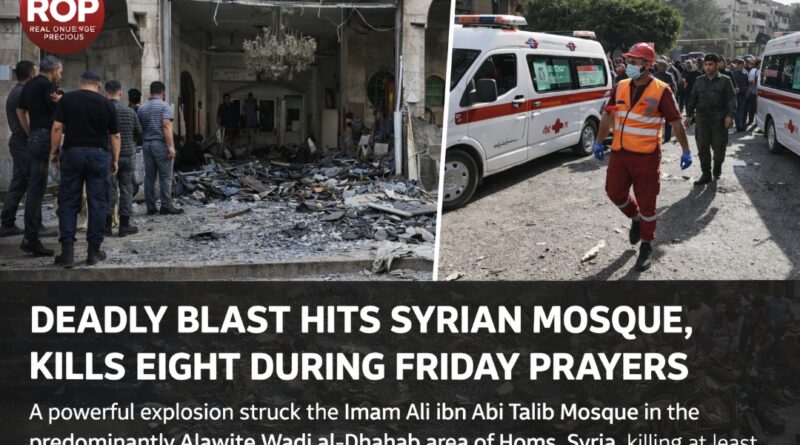
DEADLY BLAST HITS SYRIAN MOSQUE, KILLS EIGHT DURING FRIDAY PRAYERS
A devastating explosion struck the Imam Ali ibn Abi Talib Mosque in the Wadi al-Dhahab neighbourhood of Homs, Syria, on Friday, December 26, 2025, during congregational Friday prayers, killing at least eight worshippers and leaving 18 others injured. The targeted district is known to be a predominantly Alawite community, raising concerns about possible sectarian motives behind the attack.
According to reports from Syrian state media and regional security sources, the blast occurred at one of the busiest prayer moments of the week, triggering widespread panic as worshippers attempted to flee the building. Eyewitness accounts suggest that the explosion originated from explosive materials planted inside the mosque, though authorities have yet to release conclusive forensic findings.
Emergency Response & Investigation
Immediately after the explosion, Syrian security personnel sealed off the surrounding streets, restricting movement in and out of the district. Emergency medical teams were deployed to the scene, where the wounded were given first aid before being transported to nearby hospitals in Homs for further treatment. Local health officials confirmed that some victims were in critical condition, citing blast trauma and smoke inhalation.
Syria’s Interior Ministry condemned the attack, describing it as a “cowardly act of terrorism aimed at destabilizing the nation and sowing fear among peaceful citizens.” Despite the strong condemnation, no militant group has officially claimed responsibility at the time of this report.
Investigators from the national counter-terrorism unit have begun reviewing security footage, intelligence logs, and witness statements to trace those behind the bombing. Security experts warn that the attack bears similarities to previous insurgent bombings that have targeted places of worship in conflict-affected zones across the country.
Background
The explosion adds to a long list of security incidents in Homs, a city that has remained vulnerable even years after Syria’s civil conflict peaked. Although active large-scale warfare has reduced in recent years, pockets of extremist activity and sectarian tension persist, especially in areas tied to minority communities.
Global Reactions
Regional governments and international observers have expressed concern over the renewed targeting of religious centers. Analysts say such attacks are often designed to provoke distrust between communities and create psychological dominance, even when military objectives are unclear.
Authorities continue to urge calm as the investigation unfolds, assuring citizens that efforts are underway to prevent future incidents and bring perpetrators to justice.
