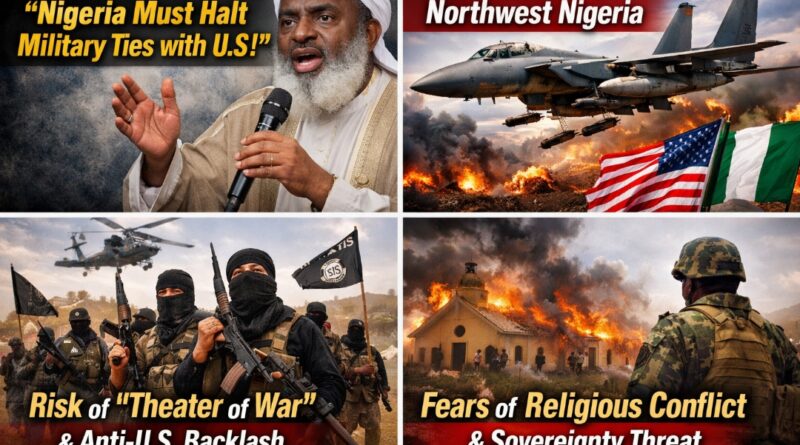
THIS IS THE MISTAKE NIGERIA MADE — GUMI WARNS US MILITARY TIES MAY TURN NIGERIA INTO WAR THEATER
Sheikh Ahmad Gumi, a Nigerian Islamic scholar and former military officer, has called on the Federal Government to halt all forms of military cooperation with the United States following confirmed U.S. airstrikes in Northwest Nigeria on December 25, 2025, which targeted ISIS-linked militants in Sokoto State.
Gumi’s statement strongly challenged the narrative behind the intervention, arguing that terrorists do not genuinely fight terrorists but may use counter-terrorism operations as cover for political, economic, or strategic motives while innocent civilians bear the real cost.
According to Gumi, Nigeria must resist becoming a battleground for foreign ideological conflicts. He stressed that no nation should allow its land to become a war theater, nor should it permit neighboring nations or global powers to convert diplomatic cooperation into national enmity.
A key part of his warning centered on religious framing. He condemned claims that the U.S. was intervening specifically to “protect Christians,” noting that such positioning risks dividing the nation, amplifying religious polarization, and provoking retaliation from extremist factions that define themselves in opposition to U.S. global influence.
Gumi further cautioned that U.S. military presence could inadvertently invite anti-U.S. insurgent forces into Nigeria, escalating insecurity rather than resolving it. He argued that such a development would weaken Nigeria’s autonomy and compromise its territorial and political sovereignty.
While acknowledging that Nigeria may require foreign military support, Gumi recommended that cooperation should be strategically diversified. He pointed to China, Turkey, and Pakistan as nations that could provide effective military assistance without aggravating religious or geopolitical fault lines within Nigeria.
The Nigerian government confirmed that the airstrikes were carried out in collaboration with Nigerian authorities under existing counter-terrorism agreements. However, Gumi maintained that the long-term consequences of continued U.S. military involvement must be critically evaluated beyond short-term tactical gains.
His remarks have ignited nationwide debate, with security analysts, policymakers, and citizens weighing the benefits and risks of foreign military cooperation in Nigeria’s fight against terrorism, insurgency, and banditry
